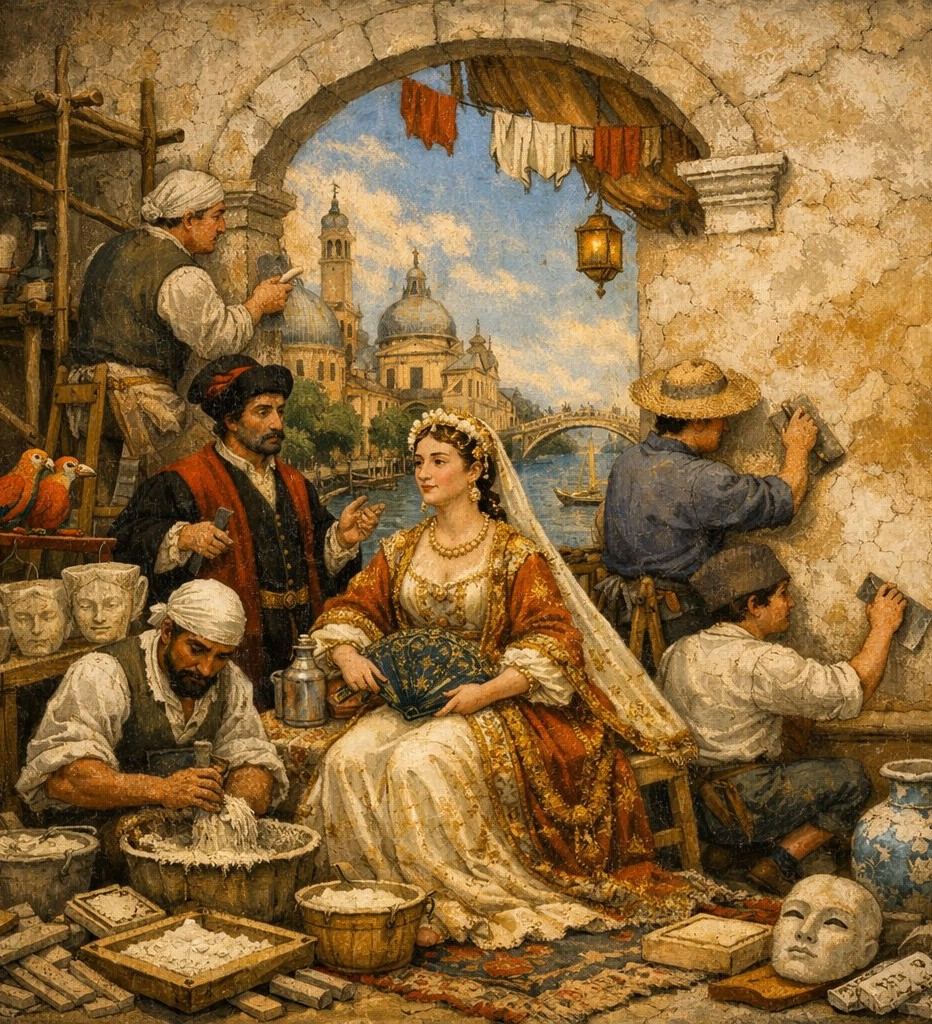
When you run a hand across a burnished lime wall, you are touching a technique that is older than most of the buildings it now decorates. Venetian plaster did not begin in Venice, and it did not begin as a luxury. It began as a practical way to make ordinary walls look and behave like stone, and it has been reinvented several times since.
Rome: Marble Dust and the Polished Wall
The clearest early description comes from the Roman architect Vitruvius, writing De Architectura in the 1st century BC. In Book VII, Chapter 3, he lays out a wall build-up that any modern plasterer would recognize: a rough first coat, then several coats of lime and sand, then several finer coats of lime mixed with marble dust, each laid on before the previous one has fully dried.
He is specific about the numbers. In Joseph Gwilt's 1826 translation: "Thus, with three sand coats, and the same number of marble-dust coats, the walls will be rendered solid." He also warns what happens when builders cut corners: "When only one coat of sand and one of marble-dust are used, it is easily broken, from its thinness."
And he describes the result that still defines the finish: plaster that, "when well polished, not only shines," but reflects images like a mirror, and that "throws out the colours mixed therein with great brilliancy."
Vitruvius never uses the word marmorino, and Roman wall stucco was a different system from modern Venetian plaster. But the principle of lime, crushed marble, layered thin coats and polishing is the same one. The painted walls of Pompeii, preserved under the ash of 79 AD, are the best-known surviving examples of this Roman tradition of smooth lime plaster.
Venice: Thrift, Weight and Water
The technique largely faded with Rome and returned in the Renaissance, when classical ideas were fashionable again. In Venice it found ideal conditions.
According to the history recorded by plaster historian Giovanni Polistena and summarized in the Wikipedia entry on Marmorino, the first written record of marmorino work is a 1473 building contract with the nuns of Santa Chiara on Murano. That contract specified a base of lime and coccio pesto, crushed terracotta from brick waste and old roof tiles.
Three features of Venice made the finish make sense:
- Waste stone was everywhere. A city that imported marble for its palaces produced plenty of offcuts and dust. Grinding them into plaster turned waste into a finish.
- Sand was hard to get. In a city built on water, moving bulk sand was difficult. Crushed brick and marble were local.
- Weight mattered. Venice stands on timber piles driven into the lagoon. A thin plaster that looked like stone put far less load on foundations than real stone cladding.
The crushed terracotta in the base coats gave the lime mild hydraulic behavior, helping it cope with damp. The finish coats were usually white, imitating the pale Istrian stone used throughout the city's facades and trim.
Palladio and the Art of Looking Like Stone
The Renaissance architect Andrea Palladio (1508–1580), whose villas in the Veneto shaped architecture for centuries, built largely in brick. His columns and walls were finished in lime stucco to read as stone. That approach, a humble structure with a refined lime skin, is the same logic behind Venetian plaster today.
Decline: From Prestige to "Economical Substitute"
Marmorino held its prestige for centuries. By the end of the 1800s, it was increasingly seen as a cheap substitute for marble rather than a craft in its own right. At the same time, construction was changing. Portland cement, patented in 1824, and faster-setting gypsum plasters gradually replaced slow-curing lime across most building work. Lime skills survived mainly in restoration and among a shrinking number of artisans.
Revival: Carlo Scarpa and Modern Architects
The comeback came from architecture rather than decoration. The Wikipedia history credits the Venetian architect Carlo Scarpa (1906–1978) as a key reason the finish became fashionable among modern architects again toward the end of the 1970s. Scarpa's work drew deeply on Venetian craft traditions, and he showed that lime finishes belonged in contemporary rooms, not only in palazzi.
From there, manufacturers began producing ready-mixed lime plasters, many with small organic binder additions so they could be applied over drywall and wood panels instead of masonry. Later came fully acrylic imitations, which brought the look to a mass market. Our guide to real lime versus acrylic Venetian plaster explains how to tell them apart.
The Family Tree of Italian Lime Finishes
| Term | What It Means |
|---|---|
| Grassello di calce | "Fat lime": slaked lime aged as a smooth putty; the base of high-gloss finishes |
| Marmorino | Lime with marble powder and granules; satin, stone-like texture |
| Stucco veneziano / Venetian plaster | Thin, burnished coats of lime and fine marble; the polished, glossy look |
| Coccio pesto | Crushed terracotta mixed into lime; historic base coat with damp resistance |
| Scagliola and sgraffito | Related decorative techniques: inlaid imitation marble and scratched layered designs |
Timeline at a Glance
| Period | Milestone |
|---|---|
| 1st century BC | Vitruvius describes layered lime, sand and marble-dust stucco in De Architectura |
| 79 AD | Pompeii's lime-plastered walls are preserved by the eruption of Vesuvius |
| 15th century | Classical finishes return in the Venetian lagoon |
| 1473 | Earliest recorded marmorino contract, Santa Chiara, Murano |
| 16th century | Palladio finishes brick buildings in lime stucco to read as stone |
| Late 1800s | Marmorino viewed as a cheap marble substitute; cement and gypsum take over |
| Late 1970s | Revival among modern architects, helped by Carlo Scarpa |
| Today | Lime, hybrid and acrylic versions used worldwide |
Why the History Matters in Miami
South Florida has a long relationship with Mediterranean architecture. Vizcaya, the Italian Renaissance-style estate built on Biscayne Bay between 1914 and 1922, and the Mediterranean Revival streets of Coral Gables were built on the same idea Palladio used: give a simple structure a refined surface that reads as old stone.
Modern Miami adds its own twist. Poured-concrete towers in Brickell and Miami Beach provide exactly the kind of mineral substrate lime has always liked, and the humidity rewards a finish that breathes. A burnished Venetian plaster or Marmorino wall in a glass-walled condo is not a period costume. It is the same craft, still doing what it has always done.