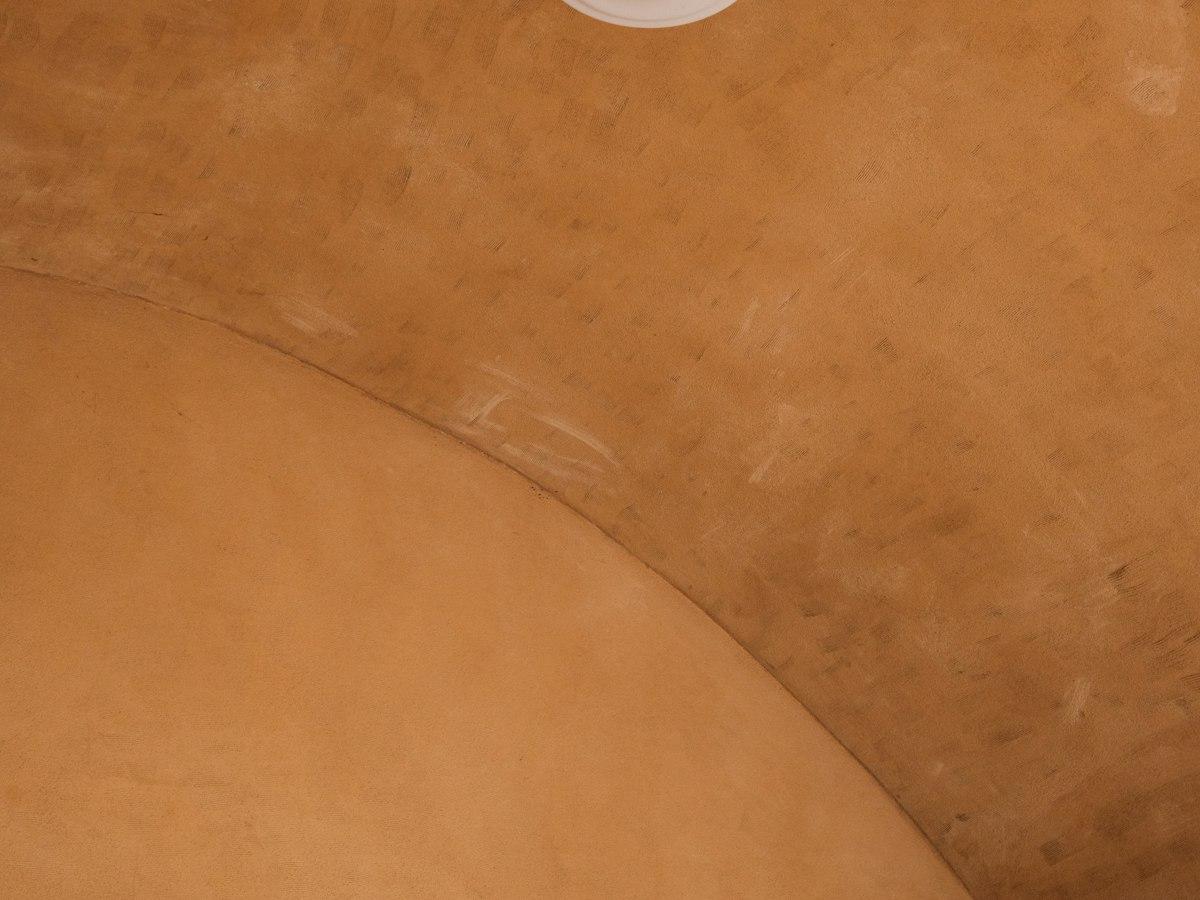
"Venetian plaster" is not a protected name. In the United States it is used for two very different families of product. One is the traditional material: slaked lime putty mixed with marble powder, applied in thin coats and burnished with a steel trowel. The other is a water-based acrylic product, filled with marble dust, calcium carbonate or other minerals, that is troweled to look similar.
Both can be beautiful. They are not the same material, they do not age the same way, and they should not cost the same. If you are comparing quotes, the first question is not "how much per square foot?" It is "what is actually going on my wall?"
What Real Lime Plaster Is
Traditional Venetian plaster and Marmorino are built on calcium hydroxide, the slaked lime that the Italian trade calls grassello di calce when it is aged as a putty. Polished lime plasters are typically mixed with a large share of marble powder; the Wikipedia entry on polished plaster notes that a lime-based polished plaster "may contain over 40% of marble powder."
Lime does not dry like paint. It carbonates: the calcium hydroxide slowly absorbs carbon dioxide from the air and turns back into calcium carbonate, which is chemically the same mineral as limestone and marble. That is why a well-made lime wall reads as stone rather than as a coating. The process starts within hours, but a full-thickness finish can keep curing for weeks.
Two practical consequences follow:
- Fresh lime is strongly alkaline. A saturated calcium hydroxide solution has a pH of about 12.4. That alkalinity is what makes lime naturally hostile to mold, and also why installers wear gloves and protect floors.
- Lime stays vapor-open. Moisture can pass through the finish instead of being trapped behind a film, which matters on concrete and block walls in a humid climate like Miami.
What Acrylic "Venetian Plaster" Is
Acrylic versions replace lime as the binder with an acrylic polymer emulsion, the same family of binder used in latex paint. The filler gives body and the trowel gives the look, but the wall is held together by plastic resin rather than by re-formed stone.
That brings real advantages. Acrylic products are more forgiving to apply, they flex slightly over minor substrate movement, they are less caustic to handle, and they are easier to touch up. They are also much cheaper, both in material and in labor, because the system is faster.
The tradeoffs are just as real. Acrylic finishes tend to look a little more plastic under raking light, they do not reach the same depth of burnished gloss, they form a less breathable film, and they age as a coating rather than as stone.
Hybrids Exist, and Labels Can Mislead
The line is not always clean. Many ready-mixed "lime" products include some organic binder so they will grip drywall or wood; the Wikipedia article on Marmorino notes that ready-to-use mixes are "often with glue added to allow it to be applied on non-traditional surfaces." That is not a scandal. A small acrylic addition can be a sensible engineering choice. But a product with lime in the name can still be mostly resin, so the label alone does not settle the question.
Five Ways to Check What You Are Getting
- Read the Safety Data Sheet, Section 3. Every manufacturer must publish an SDS. Lime plasters list calcium hydroxide (CAS 1305-62-0) as a hazardous ingredient because it is caustic. If the composition section lists only acrylic polymer, calcium carbonate and water, you are looking at an acrylic product.
- Ask for the Technical Data Sheet. The TDS states the binder type, coverage, recoat times and curing behavior. A lime TDS will talk about carbonation and long curing; an acrylic TDS will read like a paint sheet.
- Check the pH of the wet material. A pH strip on fresh lime putty reads around 12 or higher. Water-based acrylic products are usually mildly alkaline, often in the 8 to 9.5 range. This is a quick, objective test a contractor can show you on site.
- Watch how it burnishes. Lime takes a high, deep polish under the trowel as it tightens. Acrylic products can be smoothed, but the gloss tends to look flatter and more uniform.
- Ask how a repair is done. On lime, small repairs are blended with tinted lime and re-burnished. On acrylic, repairs are more like touching up paint. The contractor's answer tells you which system they are planning to use.
You may hear that real lime feels cool to the touch and acrylic feels warm. It is a common rule of thumb among decorators, but room temperature, sealers and wax all change how a wall feels, so treat it as a hint, not a test.
Side-by-Side Comparison
| Traditional Lime Plaster | Acrylic "Venetian" Plaster | |
|---|---|---|
| Binder | Calcium hydroxide (slaked lime) | Acrylic polymer emulsion |
| How it hardens | Carbonates back into calcium carbonate | Water evaporates, resin forms a film |
| pH when wet | About 12 or higher | Usually about 8 to 9.5 |
| Breathability | Vapor-open | Lower; forms a film |
| Maximum gloss | Deep, mirror-like when burnished | Smoother but flatter sheen |
| Repairs | Blended with lime and re-burnished | Touched up like a coating |
| Ease of application | Demanding; skilled labor | Forgiving; faster |
| Relative cost | Higher | Lower |
When Acrylic Is the Right Call
Acrylic is not the villain here. It can be the better specification for:
- High-impact commercial corridors where scuffs and luggage strikes are constant.
- Substrates that move, such as some wood and composite panels.
- Tight budgets where the look matters more than the material.
- Rental and short-life fit-outs that will be redone in a few years.
The problem is not acrylic itself. The problem is paying a lime price for an acrylic wall, or being told it does not matter.
Questions to Ask Before You Sign
- What is the exact product name and manufacturer for each coat?
- Is the binder lime, acrylic, or a blend? Can I see the SDS and TDS?
- What primer goes under it, and why?
- How many coats, and how is the final coat burnished?
- How is the finish sealed: wax, Marseille soap, or a synthetic sealer?
- How would you repair a scratch two years from now?
A contractor who works in lime will answer these without hesitation. If you want help reading a spec, our architectural plaster specification checklist walks through the same points, and our cost per square foot guide explains why lime systems price where they do.